AMR intralogistics: Design the pilot around the material flow
A mobile robot can navigate successfully while the material flow still fails. Evaluate the complete transport service: a request, a physical pickup, delivery and confirmation that the load has changed hands. This guide proposes a pilot-planning method. It does not promise a fleet size, throughput or a customer result.
Key takeaways
- Measure transport demand and peaks before choosing vehicle numbers.
- Test physical handovers and digital confirmations together.
- Include queues, charging and recovery in performance assessment.
1. Establish real transport demand
Build an order log for representative days, recording origin, destination, load carrier, release time and required arrival. Add priority and actual handling time. Daily averages hide shift changes, bursts of demand and delays caused by upstream production.
Check when an order is genuinely ready: the container must exist, the goods must be released and a handover area must be available. Faster navigation cannot fix missing material preparation. A useful pilot route has clear ownership at both ends, rather than merely an empty corridor for a demonstration.
2. Treat handovers as system components
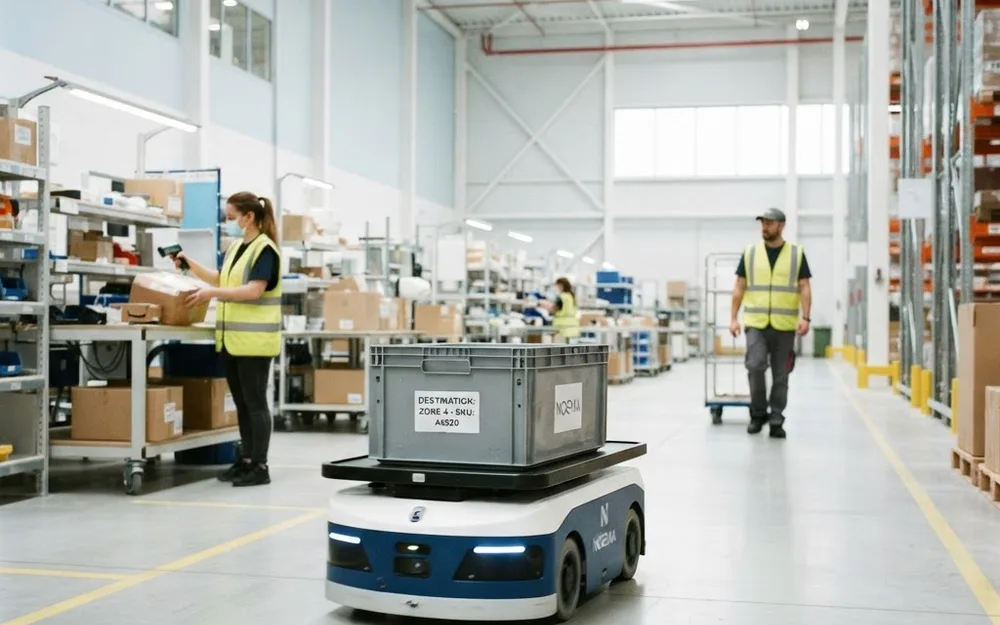
Document positioning tolerance, load restraint, available space and operator actions. Include empty-container movements. Reaching the destination is not a completed transport if the vehicle cannot release its load.
Assign explicit order states such as requested, accepted, collected, arrived, handed over and failed. Specify the authoritative system for each state and the response to a lost connection. A repeated message must not create a duplicate physical transport. Test reconciliation after a restart, not just a successful API response.
3. Assess the fleet under meaningful load
Allow for travel, pickup, drop-off, waiting, charging and operating reserve. More vehicles can create longer queues when a shared bottleneck remains unchanged. Test agreed demand peaks across the fleet instead of measuring one vehicle on an empty route.
Track completed orders, late arrivals, blocked handovers and operator interventions. Define lateness in relation to the production need. An event log makes those outcomes auditable; a single average driving speed does not explain whether production received material when it needed it.
4. Be precise about interoperability
MassRobotics describes an approach for sharing status information across mobile robots from different vendors. Shared status data should not be confused with a complete shared order-control system. [1]
Ask suppliers to demonstrate the data and commands available in the proposed configuration. Keep responsibility for dispatch, traffic, doors, lifts and error recovery explicit. A protocol name is not a substitute for exercising the interfaces needed at the actual site.
5. Include exceptions in acceptance
Plan controlled tests for an occupied destination, a missing container, a disconnected network and a missing confirmation. Agree who is notified and who can release a stalled order. Any physical testing involving people and vehicles needs a competently planned safe setting.
Acceptance evidence should include the order and exception logs, operator instruction and documented recovery procedures. Extend to additional areas when the remaining failure causes are understood and someone has accepted ownership of daily operations. A route that works only with constant engineering support is still a development project.
A checklist for your next step
- Collect order data including peak periods.
- Define both handovers and the return of empty carriers.
- Agree order states and duplicate-message handling.
- Test blockages, charging and restart during the pilot.
Frequently asked questions
How many AMRs does a factory need?
That depends on demand, handovers, bottlenecks and charging. A precise fleet size without those inputs is an assumption to validate, not an established answer.
Is a successful navigation demonstration sufficient?
It proves only part of the service. Handover reliability, order management and exception recovery also determine usable transport capacity.
Sources & further reading
AI-assisted technical guides for orientation. Sources are linked; planning examples are not customer references. Cover images are illustrative visuals from the NOEMA website.