Planning a cobot project: From one motion to a dependable robot cell
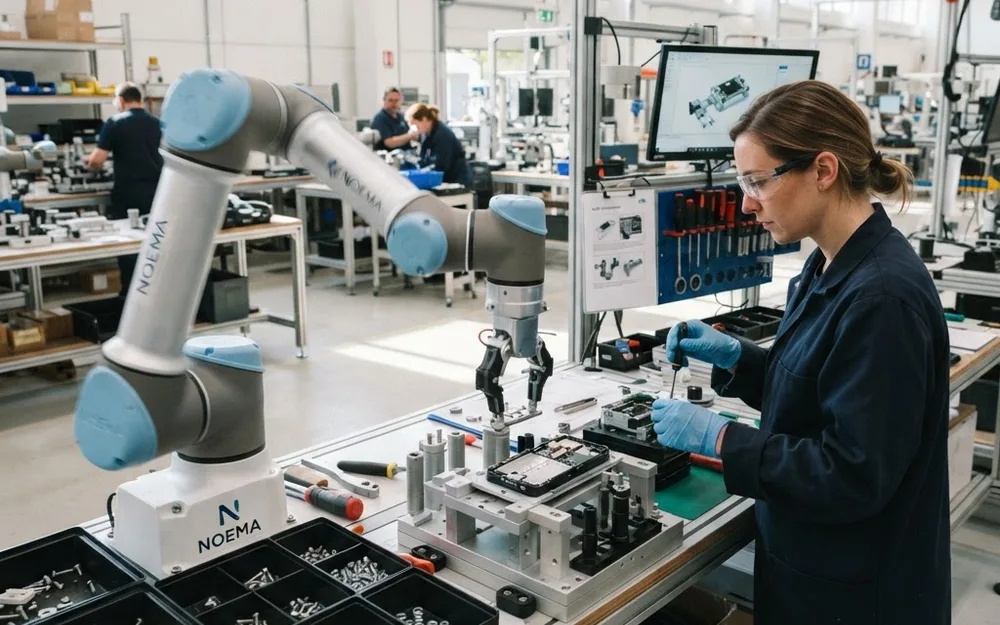
A collaborative robot earns its place through the performance of a complete cell: good parts, predictable operation and a recoverable process when something goes wrong. Start the investment decision with the workpiece and its handovers, then select the gripper, controls and robot. The framework below is a proposed planning method, rather than a report of a completed NOEMA customer installation.
Key takeaways
- Evaluate the complete application, including tooling and human tasks.
- Measure production with replenishment, rejects and recovery included.
- Give the pilot and production release separate decision criteria.
1. Define the process boundary
Write down the incoming and outgoing state of the part. Is it located in a fixture or randomly placed in a container? Must it be inspected, rotated or cleaned before gripping? Moving between two fixed positions is a different scope from taking responsibility for an entire machine-tending process.
Record product variants, surface condition, mass, centre of gravity and acceptable contact areas. Include handovers to operators and neighbouring machines. The result should be a requirements brief that competing suppliers can answer consistently. Any missing input condition becomes an explicit work package rather than an assumption hidden in a quotation.
2. Test gripping and presentation first
A successful pick demonstrates a possibility, not production reliability. Use representative parts to test variation in position and manufacturing tolerance. Include contamination, surface changes and delicate features where these occur in the real process. Decide which failed picks can be retried and which parts require inspection.
Payload assessment must account for tooling as well as the part, alongside the manufacturer's centre-of-gravity and motion limits. Select for a repeatable end-to-end task rather than one catalogue number. Improving part presentation may create more value than buying a larger arm.
3. Measure interruptions as well as motion
Break the cycle into presentation, detection, gripping, travel, processing and release. Log waiting and operator interventions separately. Compare good output per available production hour instead of the fastest movement demonstrated by the robot.
Include replenishment, changeovers and a controlled restart. If an operator must resolve every minor deviation, the cell may simply move work to a different place. Assign one process owner who can evaluate performance across the whole shift, including the periods when the engineering team is absent.
4. Give application safety its own work package
Universal Robots describes risk assessment at application level, including tooling, the workpiece and surroundings. A cobot product label does not replace that assessment. [1]
Have competent parties determine the protective measures for the actual installation. Before a pilot, agree who reviews changes to tools, programs and workstation layout. This article is a planning framework and does not replace a safety assessment for a particular installation.
5. Agree acceptance evidence before purchasing
Specify the variants, operating states and quality criteria to be tested. Acceptance should include normal production and agreed failure scenarios. Record the test duration, sample definition, permitted interventions and error-logging method so that even an unsuccessful trial produces useful evidence.
Scale only on the basis of performance under those conditions. If presentation or part tolerance remains unresolved, a focused process change may be the next sensible step. Establish a stable reference cell before deciding whether its design can transfer to more products.
A checklist for your next step
- Provide representative parts and difficult variants for trials.
- Separate feeding, tooling, protection and interface scope in quotations.
- Record good output, interventions and recovery time separately.
- Name the owners of acceptance, training and spare-parts support.
Frequently asked questions
Can a cobot automatically operate without additional safeguarding?
The robot's name cannot establish that. The actual application and its competent risk assessment, including the tool and workpiece, determine the necessary measures.
What should the first trial demonstrate?
Whether difficult representative variants can be gripped and transferred, and how the process responds to expected deviations. One ideal cycle does not answer those questions.
Sources & further reading
AI-assisted technical guides for orientation. Sources are linked; planning examples are not customer references. Cover images are illustrative visuals from the NOEMA website.